
Talk to Me
communicating the the more-than-humans

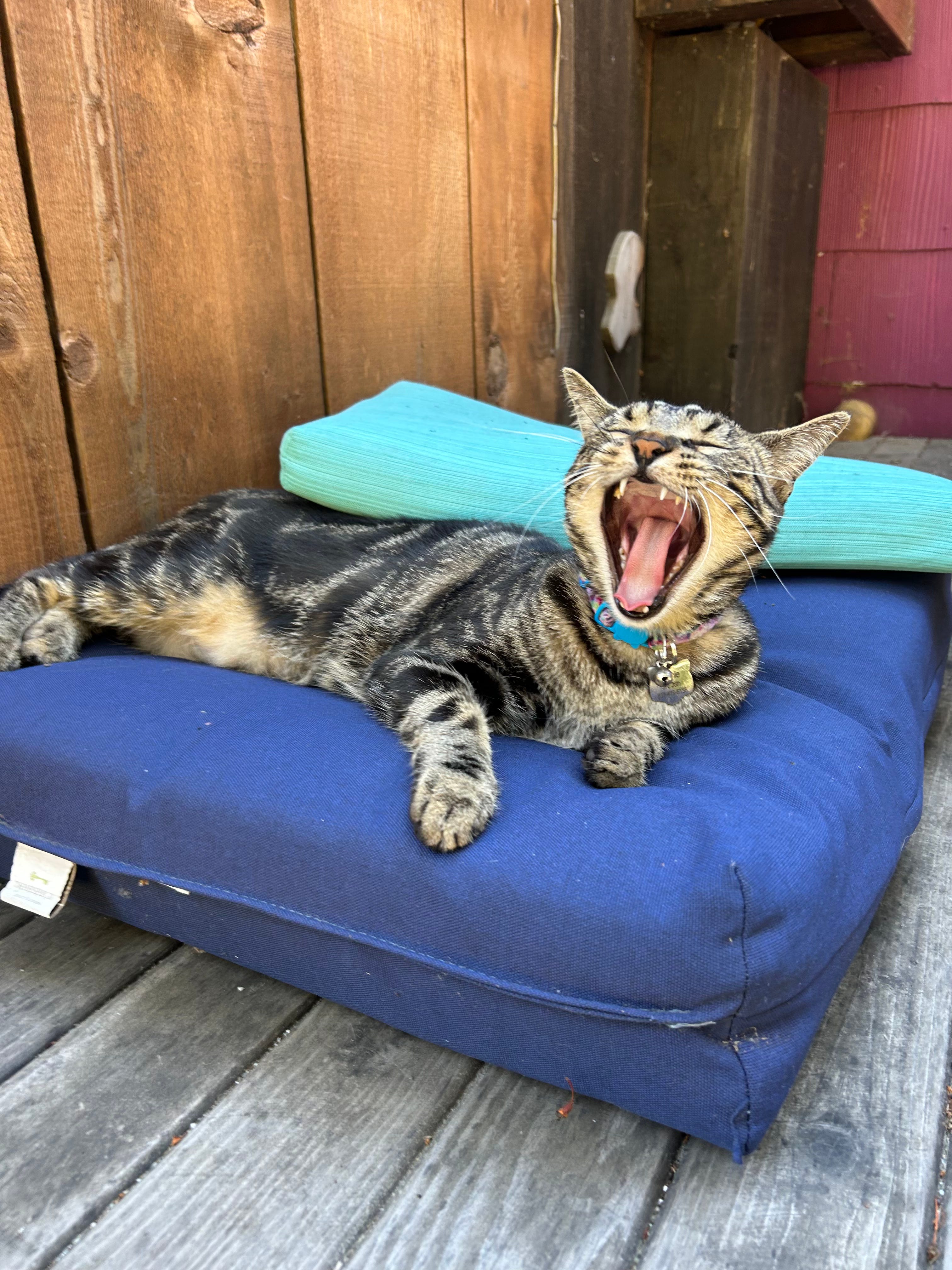
(an excuse for a cat pic? perhaps. photo by Melissa Fritchle)
My cat Hippie spies me as I cross the yard on my way home after work. As we make eye contact, her eyes get big and she presses herself to the ground, back feet gaining traction. Her tail waves. I slightly crouch and say her name with a smile in my voice and she immediately runs towards me. We don’t run into each others arms as people do in movies, Hippie veers off before reaching me and hits the backdoor before I do, but the sentiment seems the same. We are joyful to see each other after being apart (in this case for a few hours, as we spend lunch together, her rolling in the grass while I eat).
My cat and I communicate. It is not in words, although she understands many of my words at least in the behavior they are linked with. And I certainly can’t understand all the meaning in her meows but have gained an awareness of different variations and what they are saying to me. But the main way we communicate is through our bodies and through an intuitive reaching out, wanting to understand. She has come to understand that, against her instincts, my kissing her face and even belly are not a threat but gestures of love. As I have come to understand that her sharp bites, held back well before breaking the skin, are love bites not fighting.
When we seek to connect with the Wild we have to learn new languages, most of which we will never be fluent in. We cannot use our intellect to select the correct search terms to get the information we need from the other. No, we must rely on a much more opaque communication.
Which means we have to trust that we can intuit our way into connection with these other beings. This trust can be hard for us who have been taught to ignore our own bodies, to doubt sensation or emotion as “not logical”, or have been told we are imagining things that we knew to be true. It is hard because our school system said we needed to prove and justify and that our own observations or experiences don’t count. We have to claw our way back to trust in our sensing.
The lack of clarity, the continued bit of unknowing, that is present when we listen to the Wild ones around us is its own lesson. Perhaps we actually need to get more comfortable with ambiguity and not being able to distinctly pin something down. I believe that intimacy firmly includes allowing the other to be an intriguing mystery that can never be fully known, but the joy is in the trying. Being with a Wild other requires us to be in a state of opened questions and to listen in new ways. To listen by mirroring a movement or watching songs passed from one bird to the next. Communicating with the Wild keeps us in beginner’s mind – and that is a potent place to be!
To listen to one we don’t share a clear language with also requires us to reach across our differences and rely on shared emotion. We use our exquisite Mirror Neurons, a specialized group of cells that mammals have (but humans have in larger amounts) which fire mirroring parts in our brains based on emotion or behavior we see in others. So when you see someone bump their head you yourself might flinch. But also if you see someone crying you might tear up as well. We can actually strengthen our Mirror Neurons by practicing reading faces, ascribing an emotion to a facial gesture. Mirror Neurons have allowed us to learn and connect and stay safe. This aspect of our biological makeup creates empathy and helps us communicate in general.
So with the Wild ones it can be like doing advanced face reading. What might this different but similar face be saying? What might this body movement evoke? We are relying on empathy – and building it.
“Oh poo poo”, the scientifically-minded might say, or anyone who has had to jump through the hoops of empirical research, wagging their fingers. “You can’t anthropomorphize; that is just wishful thinking or putting human emotion where it shouldn’t be”. That’s not “real”.
But here is the thing. If we refuse to imagine animals, or other more-than-human beings, having similar emotions it allows us to treat them as lesser, to ignore their needs, to objectify them. Perhaps what we all need a little more of asking - How is this other like me? How are we similar? What might we share?
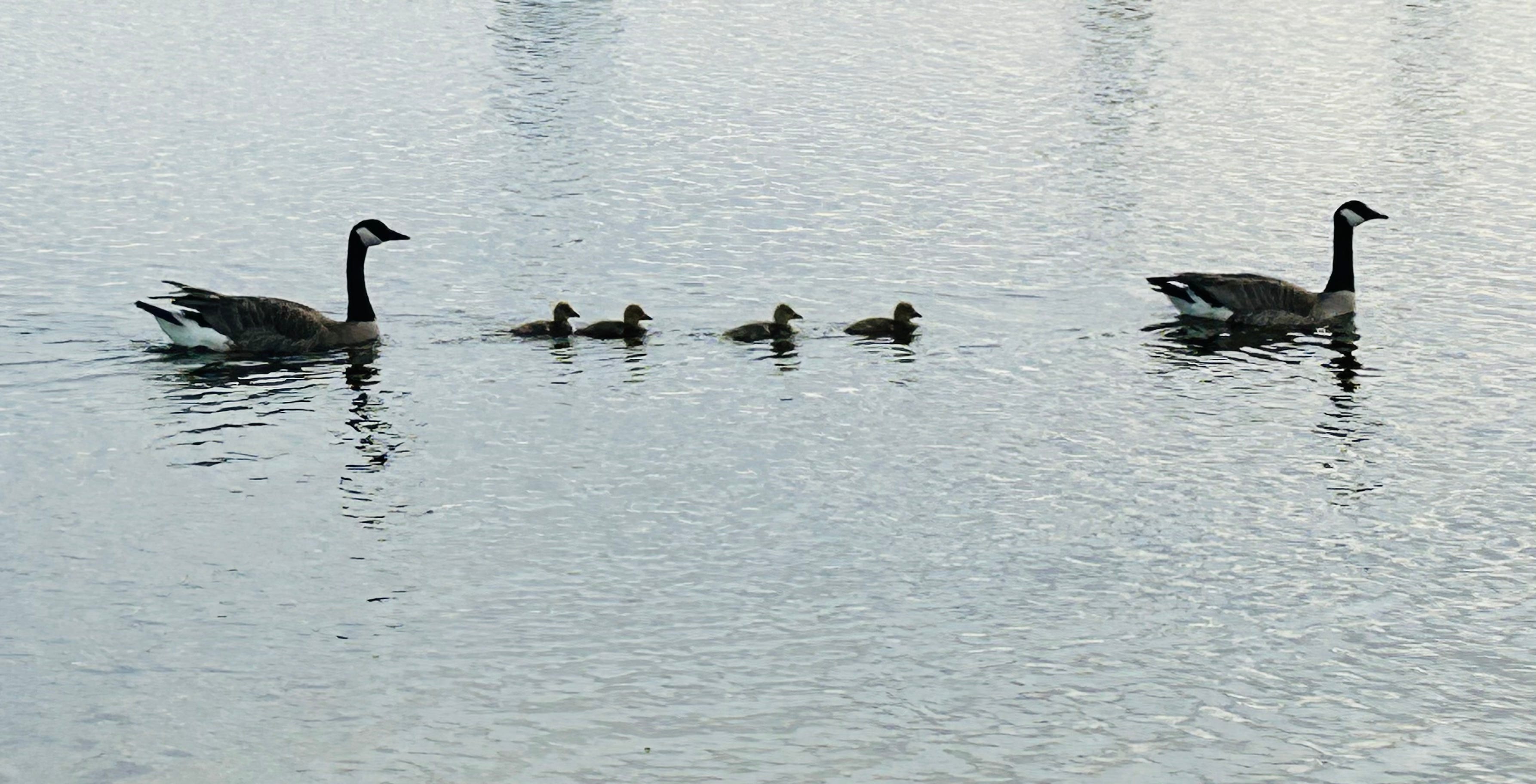
(I see keeping what we love safe. photo by Melissa Fritchle)
As Marine Biologist and author of Beyond Words: What Animals Think and Feel (2015), Carl Safina says, “This is why I try to tell the other part of the story—that our inner lives are quite similar to and no more important than the inner lives of, say, cranes or orangutans. I think this realization makes for a much richer existence, and with it, we could make some sort of philosophical progress in the world.”
“But scientists who watch wild animals realize the absurdity of not addressing an animal’s inner life. They’re not the people talking and writing about anthropomorphism either; those are largely scientists who work in lab settings. I’ve been with plenty of scientists out in the field who are constantly referring to animals as: “Oh, this guy is thinking about this, and this one is thinking like that.” – Carl Safina
(quotes from interview with Audubon magazine, 2015)
If you want a beautiful experience of easily comprehending emotions from animals I encourage you to watch the exquisite animated film Flow (2024). With no dialogue, every emotion is expressed through animal bodies and vocalizations. And your Mirror Neurons allow you to feel it with them even as you know they are just images on a screen.
And then imagine how you might communicate with a tree or a plant or a boulder or soil? Oh, how that might expand you! What might it be like to have Mirror Neurons responding to the Wind as it wraps around your house? (And by the way you already do; this is why we might say a storm is angry)
So allow yourself to feel and sense your way into communication, using emotional cues you already have. Trust that this Wild being you are observing has an inner life that is expressed in sound and gesture, like you. Don’t try to prove something as “real”, just enjoy the gifts of a richer and more connected world.